
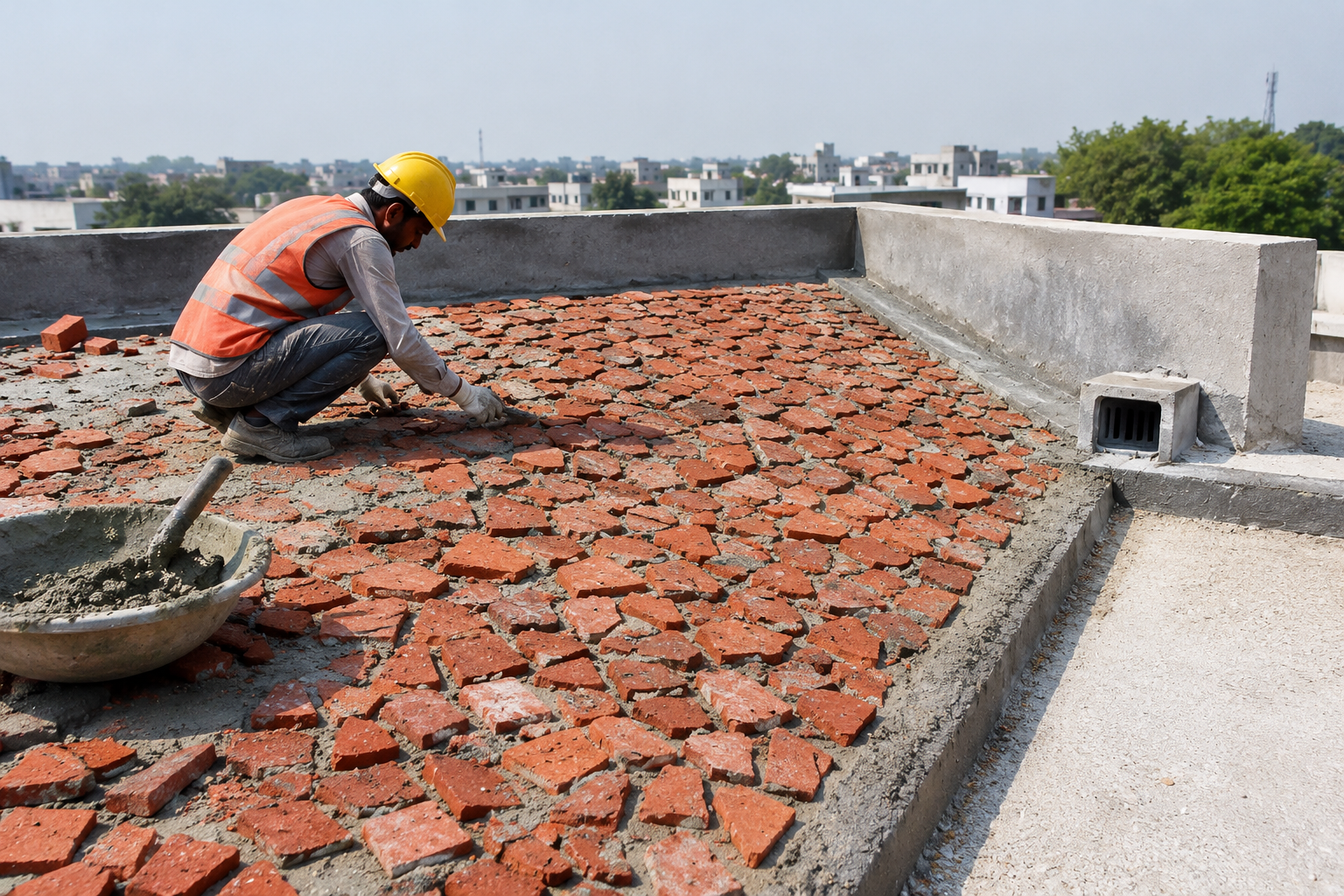
A roof does more than protect a building from rain and sunlight. It also plays an important role in keeping indoor spaces comfortable and protecting the structure from moisture. One traditional roofing method that is still used in many buildings across India is Brick Bat Coba waterproofing.
Although modern waterproofing products are widely available, Brick Bat Coba remains a practical option for selected roof types when it is designed and installed correctly. It combines brick pieces, cement mortar, and a carefully prepared roof surface to create a protective layer.
In this blog, we will explain Brick Bat Coba in simple language, including how it works, its benefits, the installation process, and the points to consider before choosing it for your building.
What Is Brick Bat Coba?
Brick Bat Coba is a traditional roof treatment in which broken brick pieces, commonly called brick bats, are laid over a prepared roof surface using cement mortar.
The layer is generally shaped to provide a slope so that rainwater flows towards the roof drains instead of collecting in low areas. Depending on the project specification, a separate waterproofing layer may also be included beneath the brick bat layer.
The main purpose is to help manage rainwater, reduce water stagnation, and provide thermal protection to the roof.
In simple words, Brick Bat Coba creates a sloping protective layer on the roof that helps water move towards the drainage points.
Why Is Brick Bat Coba Used on Roofs?
Flat roofs are common in residential buildings, factories, offices, and commercial properties. However, a roof that looks flat may still need a proper slope to drain rainwater effectively.
When water remains standing on the roof for long periods, it can increase the risk of leakage, damage to finishes, and deterioration of vulnerable areas.
Brick Bat Coba helps address these concerns by creating a suitable slope and adding a protective layer above the roof slab.
It is often considered where the project requires a cement-based roof treatment and where the existing structure can safely carry the additional load.
Key Benefits of Brick Bat Coba
1. Helps Improve Roof Drainage
One of the main benefits of Brick Bat Coba is its ability to create a slope towards rainwater outlets. Proper slope planning reduces water stagnation and helps rainwater drain away more effectively.
2. Provides Thermal Comfort
Brick has relatively low thermal conductivity compared with many dense construction materials. The brick bat layer can help reduce heat transfer through the roof, depending on its thickness, moisture condition, and overall roof construction.
This can be useful in buildings exposed to strong summer sunlight.
3. Makes Use of Brick Pieces
The method uses broken brick pieces instead of requiring every piece to be a complete brick. This can make use of suitable brick offcuts and broken pieces available on site, provided their quality is appropriate for the work.
4. Suitable for Different Building Types
Brick Bat Coba can be considered for residential houses, commercial buildings, and selected industrial roofs. Its suitability depends on the roof design, structural capacity, drainage requirements, and project specifications.
5. Can Be Repaired in Certain Cases
Where the source of a defect is clearly identified, local repairs may be possible. However, the repair method depends on the condition of the existing layer and the underlying waterproofing system.
How Is Brick Bat Coba Installed?
A good result depends more on correct preparation and workmanship than on simply placing brick pieces over a slab.
Step 1: Prepare the Roof Surface
The roof slab is cleaned to remove dust, loose mortar, dirt, and other materials that could affect the bonding of the next layer. Cracks, weak areas, and existing leakage points should be inspected before work begins.
Step 2: Check the Slope and Drainage
The roof levels are checked to identify high points, low points, and drain locations. The required slope is planned so that water can reach the outlets without unnecessary ponding.
Step 3: Apply the Specified Waterproofing Treatment
Where the design calls for a separate waterproofing membrane or coating, it is applied according to the approved system and manufacturer’s instructions. The brick bat layer should not be assumed to replace every type of waterproofing membrane.
Step 4: Lay the Brick Bats
Suitable brick pieces are placed in the specified cement mortar. Their arrangement and thickness are adjusted to achieve the required roof profile and slope.
Step 5: Fill the Gaps and Finish the Surface
The gaps between the brick pieces are filled with mortar as specified. The surface is then finished to provide the required profile and support the specified protective treatment.
Step 6: Cure and Inspect the Work
Cement-based layers require suitable curing. After the required curing period, the roof should be inspected for cracks, surface defects, drain blockages, and low areas where water may collect.
Any waterproofing test should follow the approved project procedure and account for structural loading and site safety.
Common Mistakes to Avoid
Even a traditional waterproofing method can fail when important construction details are ignored.
-
Incorrect slope: Poor levels can cause rainwater to collect on the roof.
-
Blocked drainage outlets: Mortar and construction debris can restrict the flow of water.
-
Poor surface preparation: Dust and loose material can affect bonding.
-
Insufficient curing: Inadequate curing may increase the risk of shrinkage cracks and weak mortar.
-
Ignoring joints and cracks: Roof joints, parapet junctions, pipe openings, and drain connections need suitable detailing.
-
Adding excessive load: Brick Bat Coba adds dead load to the roof. The structural capacity must be checked before installation.
-
Skipping inspection: A finished surface should be checked carefully before the roof is accepted.
Is Brick Bat Coba the Right Choice for Every Roof?
Not necessarily.
Brick Bat Coba can be useful where a sloping cement-based layer is appropriate, but it is not automatically the best solution for every building. It adds weight, takes up roof height, and depends on proper detailing and workmanship.
For some projects, a lightweight waterproofing system or another approved roofing solution may be more suitable, particularly where structural loading is a concern.
Before making a decision, consider the roof condition, expected rainfall, drainage layout, structural capacity, maintenance requirements, and the performance of the proposed waterproofing system.
Brick Bat Coba vs. Modern Waterproofing Systems
Brick Bat Coba and modern waterproofing membranes do not always serve exactly the same purpose. Brick Bat Coba is commonly used to create a sloping protective layer, while membranes and liquid-applied coatings are designed to provide a waterproof barrier.
In many roof designs, these elements may work together rather than replace one another. The correct combination should be selected according to the building requirements and approved specifications.
Final Thoughts
Brick Bat Coba is a well-established roofing method that can support effective drainage and improve roof performance when it is properly designed and executed. However, its success depends on more than the quality of the brick pieces or cement mortar.
Correct slope, sound workmanship, suitable waterproofing details, adequate curing, and proper drainage all contribute to the final result.
At Site Advisors LLP, we believe that every successful construction solution begins with understanding the site conditions and selecting the right method for the job. A carefully planned roof treatment can help reduce avoidable repair work and support the long-term performance of a building.
Planning a new roof or dealing with recurring terrace leakage? Choose a solution based on your building’s actual requirements, not simply on the most familiar construction method.
Leave a Reply